 Gobekli Tepe Turkey Tours
How Old Is Göbekli Tepe?
How old is Göbekli Tepe? The hill near Şanlıurfa was built from about 9500 BCE and abandoned around 8000 BCE, which makes its oldest structures roughly 11,450 years old. This page gives the radiocarbon dates layer by layer, explains who the builders were, when the site was found, and how it compares with the pyramids and Stonehenge. Every figure is attributed to its source, and where sources disagree both sides are given. This page deals with age and origins. For what the site is today, see the Göbekli Tepe history page, and for the carvings see Pillar 43. The bookable trips are compared on Gobekli Tepe Turkey tours.
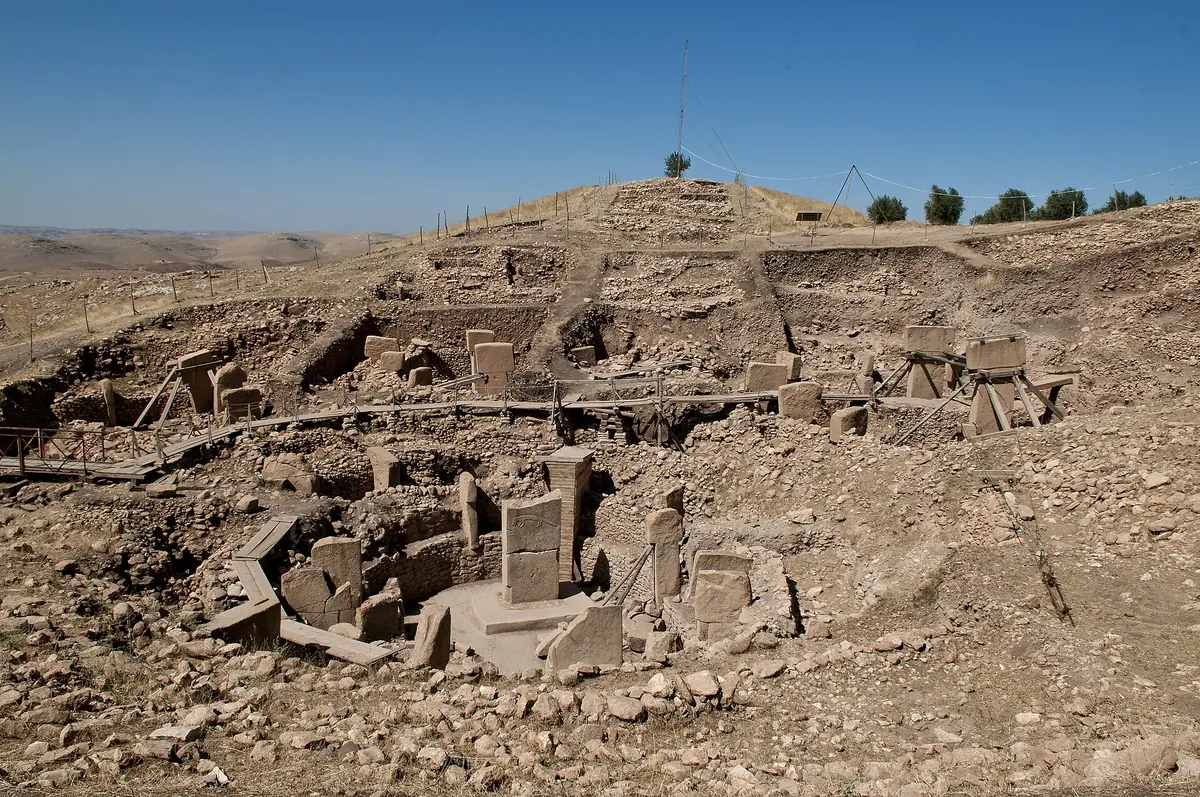
The excavated hilltop. Photo: Teomancimit, CC BY-SA 3.0, via Wikimedia Commons
Quick answer The age in one line
Göbekli Tepe was built from about 9500 BCE and abandoned around 8000 BCE, about 11,450 and 9,950 BP, per Wikipedia. The oldest known structures there are therefore roughly 11,500 years old. Hunter-gatherers built it. That makes it thousands of years older than Stonehenge or the Great Pyramid of Giza.
Key takeaways
- The revised chronology counts eight building phases spanning at least 1,500 years, with T-shaped monolithic pillars appearing in Phase 2 in the early 9th millennium BCE. See the dates layer by layer.
- The builders were foraging communities, not farmers with cities. Experiments suggest 12 to 24 people could have built the later structures in under four months. See who built it.
- The hill was first noted in a 1963 survey and systematically excavated from 1995. See when it was found.
- To see the enclosures with a guide, compare the Göbekli Tepe tours on the homepage, or read about the neighboring site in the Karahan Tepe guide.
The Dates Layer by Layer
Göbekli Tepe was not built in one moment. Its structures span well over a thousand years, and the published dates differ depending on the layer and the method.
The Key Figures and Where They Come From
Wikipedia dates the settlement to c. 9500 BCE at its start and c. 8000 BCE at its end, about 11,450 and 9,950 BP. The earliest exposed structures date to 9500 to 9000 BCE, the circular enclosures to c. 9000 BCE, and the later rectangular rooms to 8800 to 8000 BCE. A revised chronology published on Wikipedia counts eight building phases spanning at least 1,500 years: Phase 1 sits in the second half of the 10th millennium BCE, and Phase 2, when T-shaped monolithic pillars were first used, sits in the early 9th millennium BCE. The figures below are the most commonly cited ones, each with its source.
One caution. Popular travel sites often say the site is '12,000 years old'. Wikipedia's own figures give about 11,450 years for the earliest buildings, so 'roughly 11,500 years' is the safe phrasing and the 12,000 figure is a rounding that some sources use.
| Phase | Date | Source |
|---|---|---|
| Earliest exposed structures | 9500 to 9000 BCE (about 11,450 BP) | Wikipedia |
| Circular enclosures | c. 9000 BCE | Wikipedia |
| Rectangular rooms (Layer II) | 8800 to 8000 BCE | Wikipedia |
| Clay mortar, Enclosure D ring wall | 9984 ± 42 BP, calibrated 9745 to 9314 cal BC | PLOS ONE study |
| Animal tooth, Building D | 9800 ± 120 BP, calibrated 9746 to 8818 cal BC | PLOS ONE study |
| Last Pre-Pottery Neolithic activity, humus layer | 8860 ± 60 BP, calibrated 8240 to 7780 cal BC | PLOS ONE study |
| Abandonment | c. 8000 BCE (about 9,950 BP) | Wikipedia |
| National Geographic rounding | about 11,600 years old, construction ended by about 8200 BC | National Geographic |
How the Site Was Dated
The dates come from radiocarbon measurement, and the early results were messy. The first two radiocarbon dates were published in 1998 and came out 500 to 1,000 years later than expected for a Pre-Pottery Neolithic A site, per Wikipedia. Dates taken on plaster were affected by the old wood effect, so they read too old or were unreliable for dating construction. That is why the figures for any single enclosure span several centuries.
Schmidt's older three-layer model, now abandoned, put Layer III in the 10th millennium BCE (PPNA), Layer II in the 9th millennium BCE (early to middle PPNB), and Layer I as post-Neolithic to modern. The PLOS ONE study still uses that layer language, with Layer III holding the monumental circular buildings and Layer II the rectangular buildings. The broader Pre-Pottery Neolithic runs from c. 9600 to 7000 BCE on Wikipedia, with PPNA dated 10000 to 8800 BCE and PPNB 8800 to 6500 BCE, both periods defined by Kathleen Kenyon at Jericho. The Taş Tepeler project describes its subject period as roughly the 10th to 7th millennium BC.
Two practical notes for visitors. Geophysical surveys have shown at least 20 large enclosures in the mound, and a 2003 geomagnetic survey revealed at least 20 stone rings on a site of about 22 acres, of which less than a tenth is open to the sky, per National Geographic. Only a fraction has been dug, so the dates you see may shift as work continues.
Sources: Wikipedia, PLOS ONE, National Geographic, Taş Tepeler
Who Built It
The builders were not farmers and not a lost civilisation. They were foragers of the Pre-Pottery Neolithic, and the evidence for how they worked is quite specific.
Hunter-Gatherers, Not a Lost Civilisation
National Geographic reports that the builders were hunter-gatherers. At the time that article was written, no houses, hearths or cooking areas had been found, though that picture has been revised by 2019 findings suggesting a settlement with domestic structures, cereal processing and a water supply, per Wikipedia. Thousands of gazelle and aurochs bones led Schmidt to conclude the workers were fed on game brought from distant hunts, and gazelle bones suggest large-scale hunting between midsummer and autumn, which fits seasonal gatherings. Schmidt viewed the site as a ritual centre used by periodically gathering nomadic bands.
Critics find no evidence for an advanced lost civilisation behind the site, and popular media calling it the 'world's first temple' is a label, not a finding. Claims of an astronomical observatory have been largely rejected by the excavation team, per Wikipedia. The team's current view is that ritual and domestic functions coexisted rather than the site being purely cultic. Three tombs were found on the eastmost hill group, and incised human cranial fragments found in 2017 are linked to a Neolithic skull cult.
How Many People and How Long
The workforce estimates come from experiments and from the archaeologists' own arguments, and they differ. Wikipedia reports that experiments suggest 12 to 24 people could have built the PPNB structures in under four months. Moving the pillars is the harder question. Schmidt argued it needed hundreds of people, while other estimates give 20 people a year to carve one pillar and 50 to 75 people a week to move it 15 km, and still other estimates say 7 to 14 people could move pillars with ropes and lubricant. The pillars were quarried from bedrock pits about 100 m from the hilltop with flint points, and the quarry channels on the southern plateau are about 10 m long and 20 cm wide.
Building went on for at least 1,500 years across the eight phases, and Wikipedia records that it is unknown why existing pillars were buried every few decades and replaced with smaller concentric rings inside the older ones. A landslide at the end of the early PPNB also buried Enclosure D. Intentional backfilling as an explanation has fallen out of favour since Klaus Schmidt's death, per Wikipedia.
The Link to Early Farming
The site sits at the edge of the story of farming. National Geographic notes that the nearest wild ancestors of einkorn wheat grow on Karaca Dağ, about 60 miles northeast of the site, and that nearby Nevalı Çori has some of the earliest evidence of plant domestication. At Göbekli Tepe itself, a 2019 PLOS ONE study analysed 7,268 grinding tools, almost 3,400 of them handstones, and concluded that cereal processing was a significant part of subsistence. Phytoliths on the grinding surfaces show einkorn and wild and domesticated barley. Experiments grinding einkorn took 40 to 60 minutes to process 500 g, and one handstone could produce about 4,800 g of flour in eight hours, enough for an estimated 5 to 10 people.
No large storage silos have been found, so the authors read cereal production as for immediate use, and propose that grain processing plus gazelle hunting supported work feasts that mobilised the building workforce. That reading places Göbekli Tepe right at the transition: built by foragers who were already processing wild cereals on a large scale, in a region where domestication followed. 90% of the charcoal recovered at the site came from pistachio or almond trees, and the climate was wetter than today, per Wikipedia. Rainwater harvesting channels fed bedrock cisterns holding at least 150 cubic metres, and one cistern pit has a staircase of five steps.
Sources: Wikipedia, PLOS ONE, National Geographic
Stone Age Temple Mystery
The full NOVA documentary on the dig and its dating. Third-party video by NOVA PBS Official. This site did not shoot it and has no relationship with the creator.
When It Was Found
The site sat known but unrecognised for three decades between its first survey and the start of real excavation.
The 1963 Survey and the Missed T-Pillars
Göbekli Tepe was first noted in a 1963 survey directed by Halet Çambel of Istanbul University and Robert John Braidwood of the University of Chicago, per Wikipedia. That survey found over 3,000 Neolithic tools. Peter Benedict, who worked on the 1963 survey material, identified the surface stone tools as Aceramic Neolithic but mistook the upper parts of the T-shaped pillars for grave markers, which is why the site's importance was missed. National Geographic adds that a 1960s University of Chicago survey had dismissed the hill as of little interest.
Klaus Schmidt re-examined the hill in October 1994, guided there by landowner Mahmut Yıldız, and began excavations the following year in 1995, per Wikipedia. The Ministry of Culture and Tourism has supervised the excavation since 1995, according to bianet. Across the site's use, over 7,000 grinding stones have been found. Schmidt died in 2014 aged 60, after which the work continued jointly under Istanbul University, the Şanlıurfa Museum and the German Archaeological Institute, with Necmi Karul as overall director and Lee Clare coordinating DAI research since 2014.
The Farmer's Stone and the Conflicting Years
Two Turkish sources give a local farmer a role before Schmidt, but they disagree on the year, so no date is given here. The 1963 survey and the 1994 and 1995 dates from Wikipedia are the reliable anchors.
Schmidt's digs ran for two months in spring and two months in autumn, per his Wikipedia biography. His 2006 book on the site is titled Sie bauten die ersten Tempel, They Built the First Temples.
Since the 1990s, the same region has produced more sites of the same age. The Taş Tepeler project lists nine sites including Sayburç, Karahan Tepe, Sefertepe and Çakmaktepe, and Wikipedia's Taş Tepeler article counts Göbekli Tepe plus at least eleven others, naming Nevalı Çori, Hamzan Tepe and Harbetsuvan Tepe among them. Sayburç excavations began in 2021.
Sources: Wikipedia, National Geographic, Flypgs, Gazete Birlik, bianet
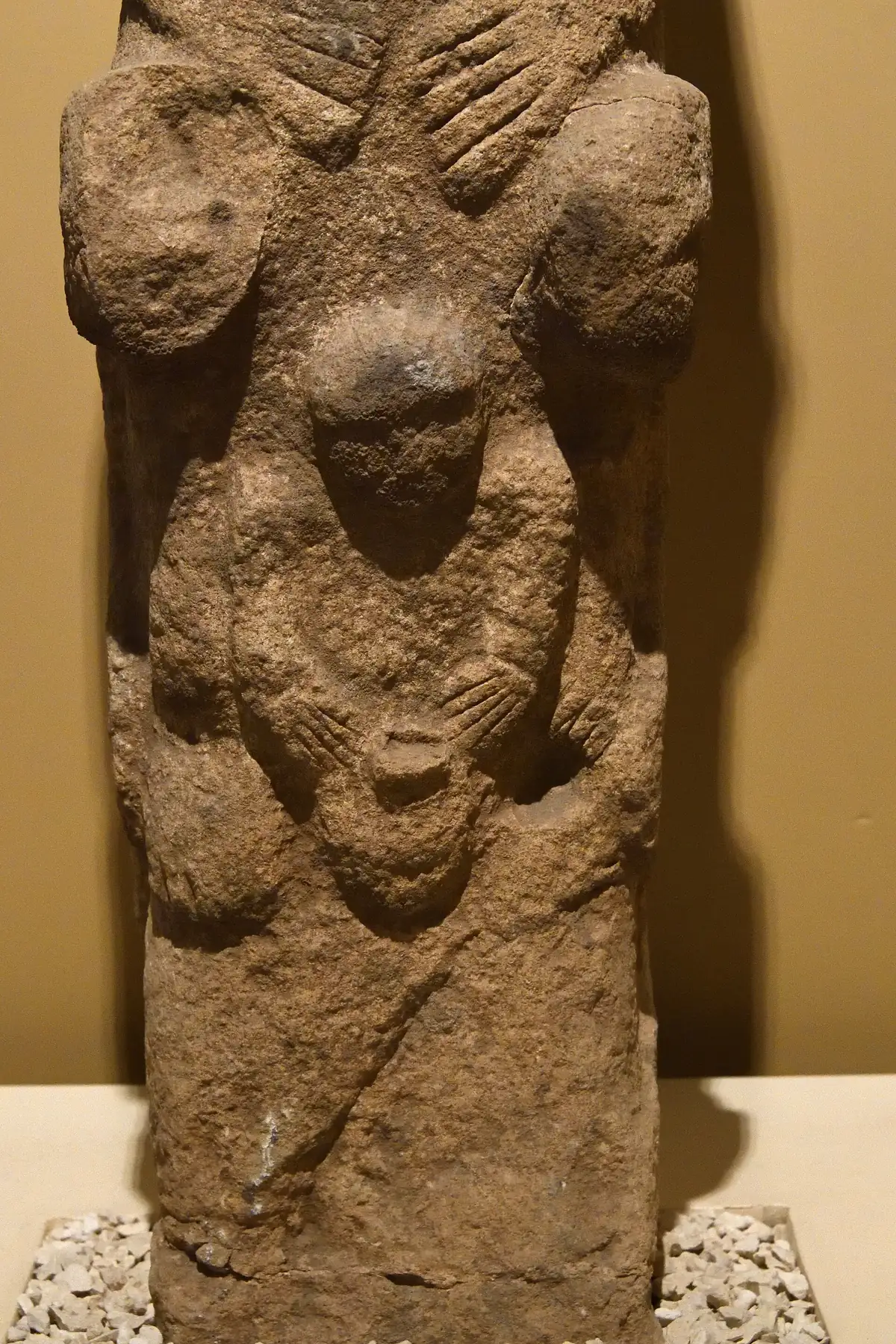
The carved totem pole from Göbekli Tepe in the Şanlıurfa museum. Photo: Dosseman, CC BY-SA 4.0, via Wikimedia Commons
Older Than What
Comparisons make the age real. The sourced figures put Göbekli Tepe millennia ahead of the monuments most people know.
The Pyramids and Stonehenge
The Great Pyramid of Giza was built around 2600 BC, with mortar radiocarbon dates of 2871 to 2604 BC, so Göbekli Tepe's earliest structures at 9500 BCE are about 7,000 years older, per Wikipedia. Stonehenge's first earthwork dates to around 3100 BC and its sarsen circle to between 2600 and 2400 BC, so Stonehenge is thousands of years younger than Göbekli Tepe's earliest structures. National Geographic states Schmidt called the site about 7,000 years older than Stonehenge and puts it at about 11,600 years old.
UNESCO's inscription text calls Göbekli Tepe 'one of the first manifestations of human-made monumental architecture', and it became Türkiye's 18th UNESCO World Heritage entry, per a 2023 Ministry press release, which places the site about 18 km northeast of Şanlıurfa city centre. Other Ministry material gives 24 km from the provincial centre, so the distance figures differ between Ministry sources.
Sites of the Same Age Nearby
Göbekli Tepe is not alone. The Taş Tepeler project, coordinated by Necmi Karul of Istanbul University with Turkish Airlines as main sponsor, lists nine sites: Sayburç, Göbekli Tepe, Karahan Tepe, Sefertepe, Çakmaktepe, Gürcütepe, Harbetsuvan, Yenimahalle and Söğüt Tarlası. Its stated aim is an inventory of settlements, camps and hunting grounds from roughly the 10th to 7th millennium BC. Wikipedia dates the Taş Tepeler sites to the Pre-Pottery Neolithic, c. 10000 to 7000 BCE, the same span as Göbekli Tepe itself.
Karahan Tepe is the best known of these. Wikipedia dates it to c. 9750 to 9400 BCE, which makes it the same era as or slightly older than Göbekli Tepe, and it lies roughly 40 to 60 km from Göbekli Tepe depending on the source. Several Istanbul trips cover both sites in one day. The Göbekli Tepe and Karahan Tepe from Istanbul day trip costs $900 per person with the return flights and entrance fees to both sites included. The Göbekli Tepe and Karahan Tepe Private Day costs $1,300 per person, also with the Istanbul return flights, though lunch is an extra there. If you prefer to start in the city, the Göbekli Tepe, Karahan Tepe and Balıklıgöl day costs from $145 per person with entrance fees and lunch included, though Karahan Tepe entry is not guaranteed.
Sources: Wikipedia, Great Pyramid of Giza, Stonehenge, Taş Tepeler, Karahan Tepe, Ministry press release
Questions About the Age of Göbekli Tepe
How do archaeologists know Göbekli Tepe is that old?
Radiocarbon dating. The published dates include clay mortar from the Enclosure D ring wall at 9984 ± 42 BP and a last Pre-Pottery Neolithic activity date of 8860 ± 60 BP in the humus layer, per the PLOS ONE study. Early dates on plaster were unreliable because of the old wood effect, which is why the figures span centuries. See the dates layer by layer.
Is Göbekli Tepe older than the pyramids?
Yes. Wikipedia dates the earliest structures to 9500 BCE and the Great Pyramid to around 2600 BC, so Göbekli Tepe is about 7,000 years older. To see it on a day trip from Istanbul with flights and tickets included, the Göbekli Tepe Day Trip by Plane costs $915.37 per person.
Is Göbekli Tepe the oldest civilization?
No, and the framing is wrong on both counts. Göbekli Tepe is a site, not a civilization, and its builders were hunter-gatherers rather than a state society, per National Geographic. Critics find no evidence for a lost advanced civilisation behind it. The Göbekli Tepe history page covers what the site was.
Why is Göbekli Tepe controversial?
The disputes are mostly about interpretation. Popular media called it the 'world's first temple', while the excavation team's current view, per Wikipedia, is that ritual and domestic functions coexisted. Claims of an astronomical observatory have been largely rejected by the team, and the reason pillars were buried every few decades is unknown. The carvings are covered in the Pillar 43 guide.
Is anything older than Göbekli Tepe?
Yes, nearby. Wikipedia dates Karahan Tepe to c. 9750 to 9400 BCE, which is the same era as or slightly older than Göbekli Tepe, and the Taş Tepeler project lists nine sites across the region from roughly the 10th to 7th millennium BC. Read the Karahan Tepe guide for details.
Who built Göbekli Tepe and when did they stop?
Hunter-gatherer communities built it from about 9500 BCE, and National Geographic reports construction appears to have ended by about 8200 BC, with Wikipedia dating abandonment to c. 8000 BCE. It is unknown why the pillars were buried every few decades. To visit with entry fees covered, the Göbekli Tepe Private Tour from Şanlıurfa costs $449 per person for 8 hours.